72.8% now prioritize AI in their testing workflows — yet most don’t trust it to operate without human oversight.
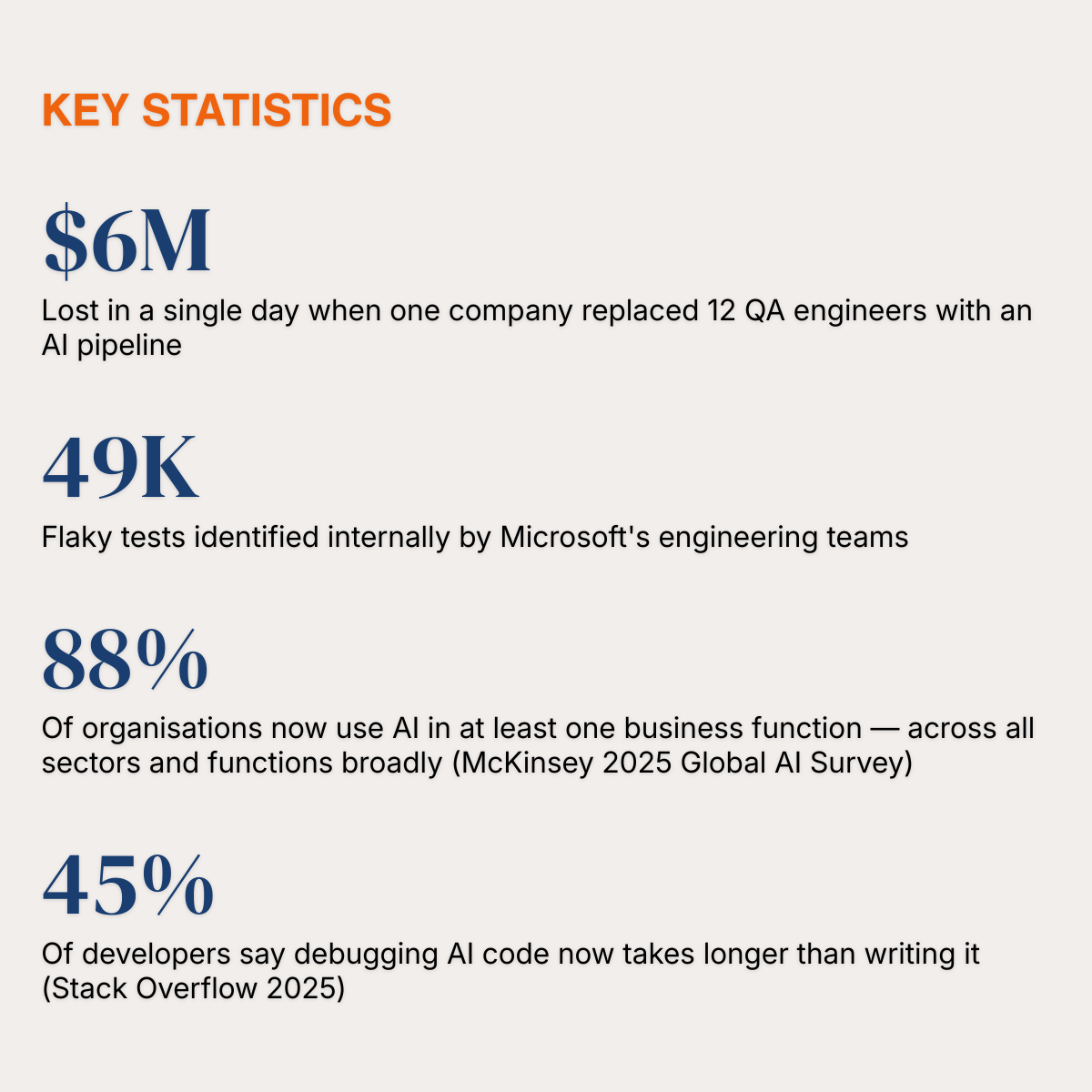
CHENNAI, TAMIL NADU, INDIA, August 18, 2026 /EINPresswire.com/ — In April 2026, a story circulated in QA circles that should give every financial-services CTO pause. A company reportedly fired its entire 12-person QA team to save $1.2 million a year, replacing it with an automated AI testing pipeline. Within a month, a hallucinated discount code made every item in the store free. The reported loss: $6 million. The company has never been named, and the figures come from a single account that went viral — but that’s exactly the point.
In financial systems, the equivalent failure isn’t a discount code. It’s a mispriced trade, a wrongly approved loan, or a sanctions check that lets the wrong transaction through. It’s an incorrect fee calculation, a failed AML screening, a broken maker-checker flow, a wrong KYC decision, or customer PII exposed through unmanaged test data. The blast radius in banking is regulatory censure, financial loss, and customer harm.
“The question is not whether AI can write tests — it’s whether anyone can trust what those tests are actually validating.” — Industry practitioner, QA financial, April 2026.
The numbers behind the headline:
A 2026 community survey of over 40,000 testing professionals, published by TestGuild, found that 72.8% now prioritize AI in their testing workflows — yet most don’t trust it to operate without human oversight. Teams are accelerating into AI-assisted development while admitting they don’t have confidence in what those tools are actually validating. The data backs the unease. CodeRabbit’s December 2025 analysis of 470 pull requests found AI-generated code carries 1.7x more defects than human-written code, with a 75% rise in logic and correctness errors.
A peer-reviewed University of Naples study (August 2025, 500,000+ code samples) confirmed AI-generated code carries more high-risk security vulnerabilities and is more prone to hardcoded debugging artifacts than human-written equivalents. The Stack Overflow 2025 Developer Survey found 66% of developers name “AI solutions that are almost right, but not quite” as their top frustration, and 45% say debugging AI-generated code now takes longer than writing it themselves.
Test suite health compounds the problem. Microsoft has internally identified roughly 49,000 flaky tests across its products. Google’s data shows 16% of tests display flaky behavior, with 84% of pass-to-fail CI transitions attributable to flakiness rather than real regressions. This is the environment into which AI-generated code is now being introduced at speed.
The bottleneck moved:
Most QA processes — and most test data — were built for a world where a human wrote the code, understood the intent, and wrote the tests. AI now writes a significant share of all three, faster than any review process designed for human pacing can absorb. The bottleneck hasn’t been eliminated. It has moved squarely into QA.
Three gaps define the problem in financial systems specifically:
1. The review gap. When AI generates both code and tests, there is no independent human baseline. Tests may pass because the AI is consistent with itself — not because the software does what the business requires.
2. The data gap. Referentially accurate, privacy-safe test data for banking — where account types, histories, and profiles must stay consistent — is genuinely hard to produce. AI-generated synthetic data introduces its own fidelity risks without human-defined governance rules.
3. The coverage gap. Running tens of thousands of tests on every release isn’t feasible. Running the wrong subset is worse than running none — it creates false confidence. Risk-based intelligence, not blanket automation, is the only answer at scale.
The regulatory dimension:
For banking and financial services, the AI testing question is not only operational — it is increasingly regulatory. Under frameworks including the RBI’s IT Governance and IS Audit Guidelines, the FCA/PRA Model Risk Management Principles (SS1/23), and the MAS Technology Risk Management Guidelines, institutions must be able to evidence who approved critical changes, what was tested, what risks were accepted, and whether the release decision had accountable human oversight. If that answer is “an AI pipeline,” that is a governance exposure — not merely a quality risk.
“Not whether AI can test faster — it can. But whether the testing it does can be evidenced, explained, and attributed to an accountable human decision point when a regulator asks.”
PCI and PII compliance requirements for test data are not new, but whether AI-generated synthetic data meets those standards remains unresolved in most institutions’ compliance frameworks. This is the gap most likely to matter in the next 18 months.
What meeting that standard requires:
Institutions that can answer the regulator’s question with confidence share five characteristics, not one:
1. Requirements traceability — a documented line from business or regulatory requirement to test case, so intent can be checked, not assumed.
2. Human-reviewed test generation — AI drafts test cases from requirements, but a human reviews and approves them before any script is generated. This is the moment that catches the gap between what requirements say and what systems actually need to do.
3. Governed BFSI test data — data that is privacy-safe, referentially valid, and produced under human-defined rules, not left to an AI agent’s best guess.
4. Risk-based regression selection — AI reads change logs against the full test inventory to identify which tests actually matter for a given change, so coverage scales without full-suite runs becoming the bottleneck.
5. Auditable release sign-off — a record of who accepted which risks and approved release, so accountability doesn’t have to be reconstructed after the fact.
None of this argues against using AI in QA — the acceleration is real and the economics are compelling. It argues against treating AI output as self-validating.
AI-led testing without governed data, structured human review, and accountable sign-off isn’t QA acceleration. It is QA on credit, with the bill due at the worst possible moment — and in banking, regulators will be the ones asking for repayment.
Srijit Das
Tristha Global Pvt. Ltd.
srijit.das@tristhaglobal.com
Visit us on social media:
LinkedIn
Inside Tristha’s AI Driven QA
Legal Disclaimer:
EIN Presswire provides this news content “as is” without warranty of any kind. We do not accept any responsibility or liability
for the accuracy, content, images, videos, licenses, completeness, legality, or reliability of the information contained in this
article. If you have any complaints or copyright issues related to this article, kindly contact the author above.

Media gallery