AI Scientists Dr. Al Naqvi and Nur Naqvi Introduce a Mathematical and AI-Based Framework for Studying Sacred Texts, Opening a New Frontier in Religious Studies
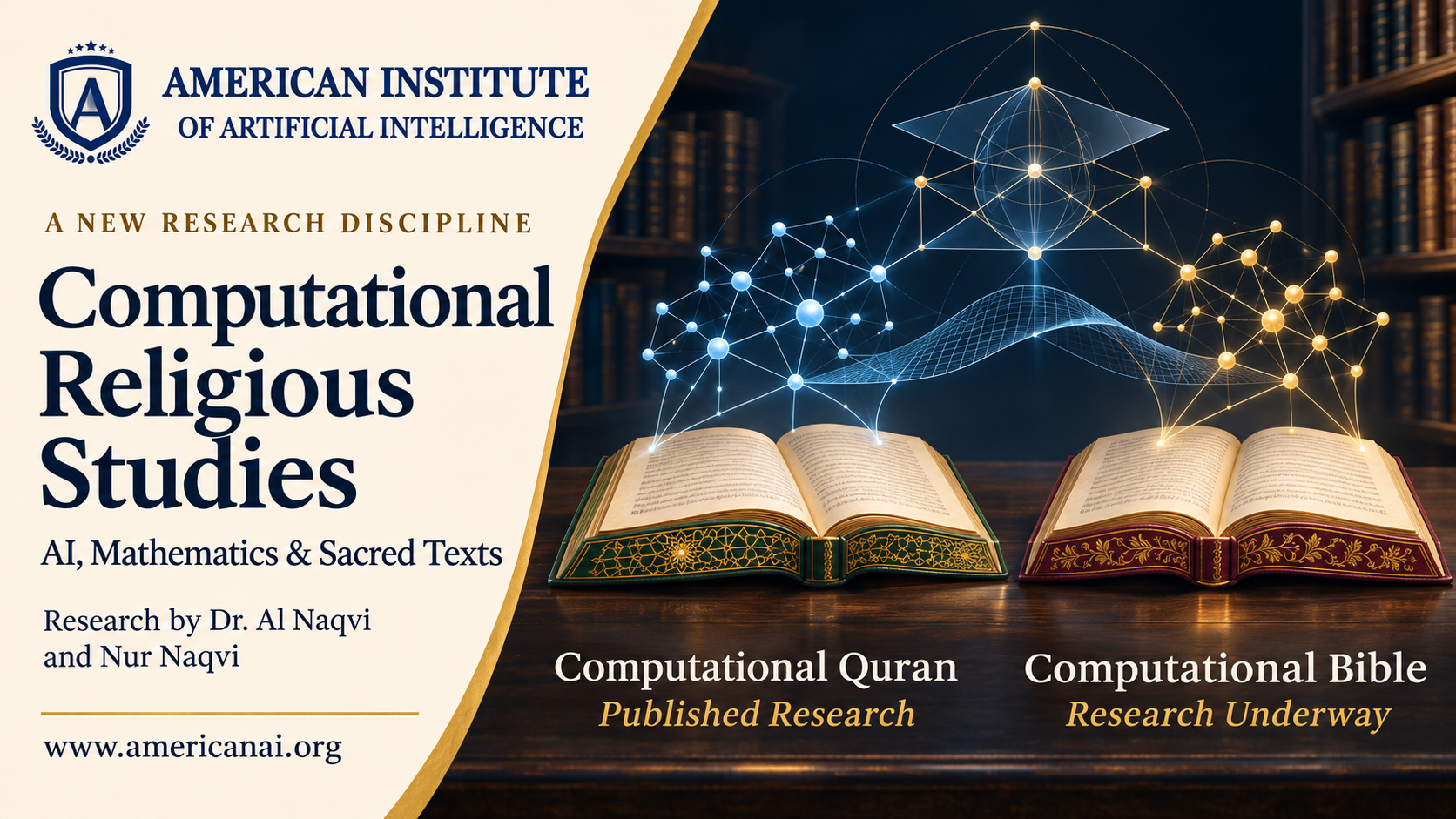
WASHINGTON, DC, UNITED STATES, November 18, 2026 /EINPresswire.com/ — The American Institute of Artificial Intelligence (AmericanAI) today announced its initiative to establish Computational Religious Studies (CRS) as a systematic interdisciplinary research discipline integrating artificial intelligence, mathematics, cognitive science, systems theory, and traditional religious scholarship.
The initiative builds upon pioneering research by Dr. Al Naqvi, Founder and CEO of AmericanAI, and Nurullah (Nur) Naqvi, Chief Technology Officer, whose work has resulted in two books examining how sacred texts can be represented, studied, and analyzed using advanced computational methods.
Their latest publication, Computational Quranic Studies: Structural, Mathematical, and Cognitive Modeling, was published by IGI Global Scientific Publishing in June 2026 and is available through international book distributors, including Kinokuniya.
The researchers are now extending their work beyond the Quran through a new Computational Bible research initiative, establishing a foundation for comparative computational studies across religious traditions.
A New Scientific Framework for Studying Religion
For centuries, religious scholarship has relied primarily on linguistic interpretation, historical analysis, philosophy, theology, and textual commentary. Computational Religious Studies introduces an additional dimension: representing religious concepts, relationships, and principles through explicit mathematical, logical, and computational models. Instead of treating sacred texts solely as collections of passages, CRS investigates how their ideas can be expressed as interconnected systems of variables, relationships, constraints, causes, and consequences. The approach incorporates mathematical modeling, knowledge graphs, ontologies, artificial intelligence, complex adaptive systems, and emerging cognitive architectures.
“We are introducing a new way of studying religious knowledge,” said Dr. Al Naqvi. “The objective is not to replace theology or centuries of religious scholarship. It is to introduce an additional scientific framework that makes complex relationships explicit, allows interpretations to be examined systematically, and creates opportunities for entirely new forms of inquiry. Just as computational biology transformed how scientists investigate living systems, we believe computational methods can open a new frontier in how humanity studies religious knowledge.”
The Computational Quran: From Sacred Text to Mathematical Models
The Naqvis’ research introduces the concept of the Computational Quran, a structured framework for expressing Quranic concepts through mathematical variables, ontologies, logical relationships, and dynamic systems. Their work includes the development of a Universal Quranic Variable Ontology (UQVO), designed to represent relationships among ethical principles, human behavior, social systems, and consequences. The research also explores how AI agents, simulations, and cognitive world models can support the investigation of these structures.
The authors have published two works advancing this approach:
The Computational Quran for the AI Era: Selected Mathematical Models of Divine Guidance (2026), an introductory work presenting selected mathematical models of Quranic guidance. (Available at Amazon)
Computational Quranic Studies: Structural, Mathematical, and Cognitive Modeling (IGI Global, 2026), a comprehensive academic volume extending the methodology through structural analysis, mathematical modeling, cognitive systems, ontologies, and computational interpretation. (Available at Kinokuniya)
“Today’s large language models are increasingly capable of processing religious texts, but language processing alone is not equivalent to structured understanding,” said Nur Naqvi, CTO of AmericanAI. “Our research explores how religious knowledge can be represented through explicit relationships, mathematical structures, and cognitive models. This creates new possibilities for explainable AI, comparative analysis, and the responsible application of intelligent systems to religious scholarship.”
Next Research Frontier: The Computational Bible
Building upon the Computational Quran, AmericanAI has begun work on the Computational Bible, extending the methodology to Biblical texts and their distinct theological and historical traditions. The initiative will investigate how Biblical concepts, narratives, ethical principles, and relationships can be modeled using computational ontologies, mathematical representations, and AI architectures.
An important objective is to develop a common research methodology that enables structured comparisons across religious traditions while respecting their theological differences and interpretive integrity.
“Religion has shaped civilizations, institutions, laws, ethics, and human behavior for thousands of years,” Dr. Naqvi explained. “Computational Religious Studies offers a new opportunity to study these profound intellectual traditions through the tools of modern science without diminishing their spiritual significance.”
Establishing an Interdisciplinary Research Discipline
AmericanAI intends to advance Computational Religious Studies as a distinct research discipline connecting computer science, mathematics, artificial intelligence, philosophy, theology, and the humanities. The Institute envisions a research ecosystem encompassing computational frameworks, structured religious knowledge, cognitive models, academic publications, and collaboration among scholars from different disciplines and faith traditions.
“Our ambition goes beyond publishing books,” said Dr. Naqvi. “We want to help establish the intellectual and methodological foundations for a discipline that brings religious scholarship and computational science into meaningful dialogue.”
About the American Institute of Artificial Intelligence
Founded in 2016, AmericanAI is an AI research, education, and professional standards organization engaged in advanced AI architectures, transformer models, world models, autonomous systems, and interdisciplinary scientific research. Dr. Al Naqvi is an AI scientist, former Fortune 500 executive, and author of 17 books, including publications with Wiley. Nur Naqvi serves as CTO of AmericanAI and leads advanced AI engineering and research initiatives.
Book Information
Computational Quranic Studies: Structural, Mathematical, and Cognitive Modeling
Authors: Ali Naqvi and Nurullah Naqvi
Publisher: IGI Global Scientific Publishing
ISBN (Softcover): 9798337369419
Available through: IGI Global and international book distributors, including Kinokuniya.
The Computational Quran for the AI Era: Selected Mathematical Models of Divine Guidance
Authors: Ali Naqvi and Nurullah Naqvi
Publisher: American Institute for AI & Quantum
ISBN: 9798218929381
American Institute of Artificial Intelligence
Website: www.americanai.org
Marya Naqvi
AmericanAI
+1 202-823-7444
Visit us on social media:
LinkedIn
Legal Disclaimer:
EIN Presswire provides this news content “as is” without warranty of any kind. We do not accept any responsibility or liability
for the accuracy, content, images, videos, licenses, completeness, legality, or reliability of the information contained in this
article. If you have any complaints or copyright issues related to this article, kindly contact the author above.

Media gallery