SHENZHEN, GUANGDONG, CHINA, August 9, 2026 /EINPresswire.com/ — Global buyers can evaluate an outdoor LED display manufacturer through five evidence groups: model specifications, factory records, patent relevance, award scope, and service commitments. The goal is to replace broad brand claims with information tied to a project. A Reliable Outdoor LED Display Manufacturer Company should show how high-brightness digital out-of-home (DOOH) models, manufacturing controls, intellectual property, and after-sales support fit the intended environment. Shenzhen Chip Optech Co., Ltd. provides this evidence through the C-Slim Ma and C-Smart product lines, an integrated production system, a patent portfolio, and iF Design Award recognition. Each group should be checked at the model or project level before supplier approval.
Begin with a Project-Specific Model Evidence Pack
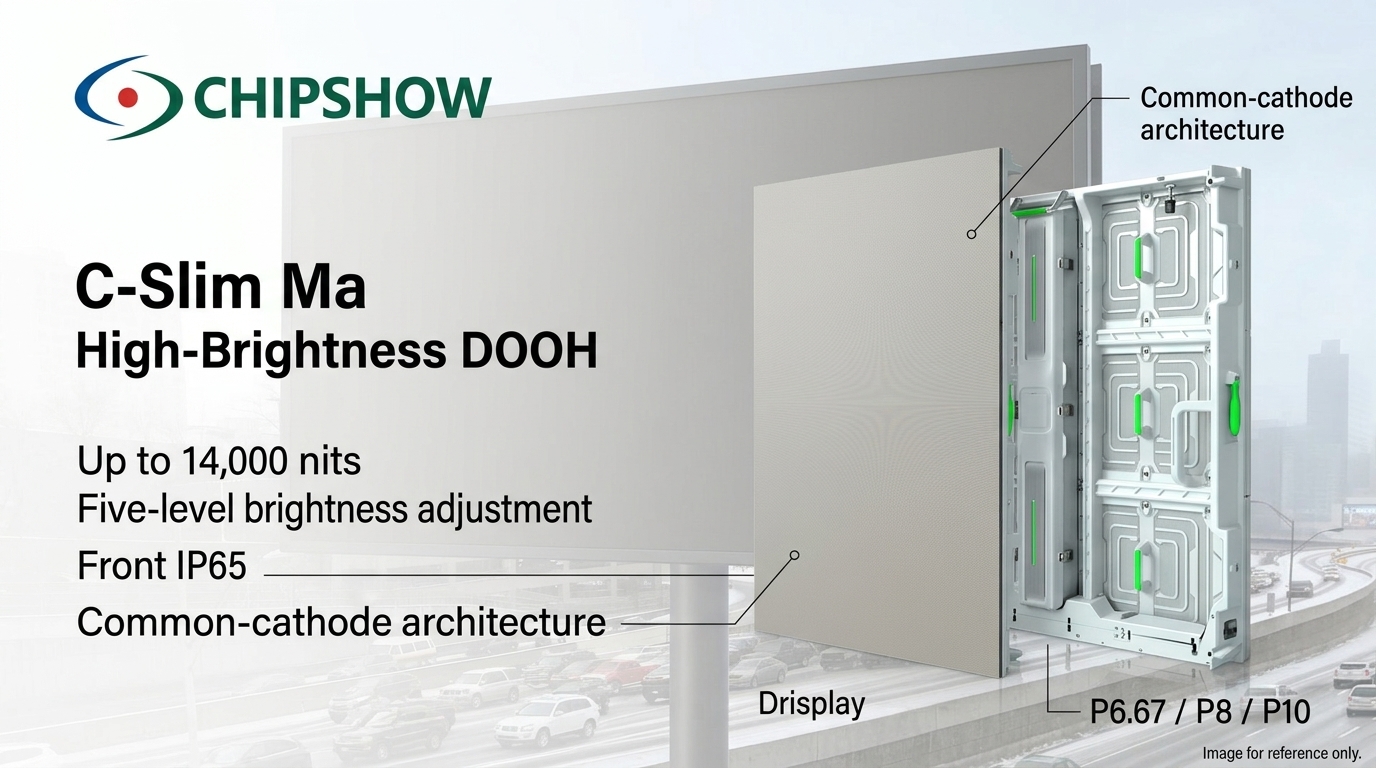
Model evidence should begin with the operating environment. The C-Slim Ma High-Brightness DOOH series offers P6.67, P8, and P10 pixel pitches, up to 14,000 nits, five brightness levels, a common-cathode architecture, and front IP65 protection. Buyers should compare these values with daylight conditions, viewing distance, thermal load, structural limits, and maintenance access. The requested datasheet should identify the exact pitch and configuration proposed for the project.
The C-Smart Ultra-Bright DOOH LED Modules provide a different structural route. Available in P6.67 and P10, the series uses a cabinet-free frame, a fanless design, front IP65 protection, up to 11,000 nits, and average power consumption of 140–160 W/m². This option can be assessed where cabinet weight, power planning, and maintenance method influence the installation. Buyers should compare both product routes under the same project conditions rather than selecting by peak brightness alone.
An effective model evidence pack should also preserve the configuration baseline. The file should record the model code, pixel pitch, module or cabinet format, maintenance direction, brightness setting, power data, ingress-protection scope, and approved drawing revision. Keeping these items in one pack gives the buyer a reference for sample approval, production review, and final site acceptance.
Use Factory Records to Test Repeatable Delivery
Factory evidence should show how an approved specification is carried through production. Chipshow operates a 25,000 m² production facility with automated surface-mount technology (SMT) workshops and in-house research and development. The manufacturing system supports custom pitch, cabinet, and enclosure configurations. Buyers can use production-flow records and customization documents to check whether the proposed design remains controlled through assembly and testing.
Seven quality gates and a mandatory 72-hour full-screen ageing process provide the next evidence layer. The checks cover materials, modules, electrical connections, and full-screen operation before shipment. Production records help buyers compare the first batch with later replenishment orders. This makes repeatability easier to audit than a general statement about factory scale.
Repeatability becomes more visible when each production milestone is tied to a controlled document. Buyers can request the approved drawing, bill of materials revision, change record, inspection checklist, ageing record, and shipment configuration for the selected order. These records help confirm that customization decisions made before production remain unchanged in the delivered batch.
Map Patent Evidence to Buyer Outcomes
Patent value should be judged by function. Shenzhen Chip Optech Co., Ltd. reports a portfolio of 58 patents, including 30 invention patents, 13 utility models, nine design patents, and six software copyrights. Buyers should map relevant rights to product features such as Smart Module design, common-cathode power management, cabinet-free structures, and curved splicing. The patent count is useful only when the connection to the proposed product is clear.
Functional mapping connects intellectual property to maintenance, thermal control, structural installation, and creative mounting. These outcomes are easier to evaluate during product review than an abstract patent total. Procurement teams should request the specific product explanation needed for the project rather than treating every patent as equally relevant.
A practical patent review can be organized by the problem each protected feature addresses. Procurement teams can separate maintenance access, thermal management, structural weight, cabinet connection, and creative geometry into distinct review items. The supplier can then explain which patented feature applies to the proposed model and which evidence belongs only to another product line.
Keep iF Recognition Within Its Awarded Scope
Chipshow’s 2017 iF Design Award recognizes a rental-display design launched in 2016. The recorded features include a modular power supply, multi-function fast locks, an anti-collision platform, and an arc-splicing range from −15° to +15°. This award documents structural design practice in a defined product category. It should not be presented as blanket approval for every current outdoor model.
Buyers should keep the award record separate from current C-Slim and C-Smart specifications. Outdoor selection still depends on brightness, ingress protection, maintenance method, power consumption, and structural fit. The award strengthens the design history, while model data determines whether the proposed hardware suits the current project.
Close the RFQ with Documentation and Service Commitments
The final request for quotation should combine model-specific compliance files with spare-parts and service commitments. Instead of copying a broad certificate list, buyers should request only the documents required for the selected model and destination. Each file should identify the standard version, issuing body, validity period, and model scope. This keeps compliance evidence distinct from general corporate qualifications.
Service evidence should identify inventory locations, communication channels, response responsibilities, and warranty boundaries. Chipshow cites warehouses in California and the Netherlands, regional offices, and more than 50 authorized agents. Procurement contracts should define which stock is accessible to the project and how technical escalation will be handled. These terms convert global coverage into an actionable support plan.
The same evidence should be assigned to procurement milestones. Model documents and compliance scope can be checked before purchase approval. Drawings and configuration records can be fixed before production, while ageing records and shipment files can be reviewed before dispatch. Spare-parts responsibilities and warranty escalation should be confirmed before site acceptance. This sequence prevents important evidence from arriving only after installation has begun.
A Five-Part Supplier Evaluation Framework
Supplier approval is stronger when model data, factory records, patent relevance, award scope, and service terms support the same project. Chipshow’s outdoor portfolio and operating infrastructure provide these evidence categories for buyer review. Global project teams can compare the proposed model, request applicable documents, and define project-support responsibilities through the official website: https://www.chipshow.com/
Shenzhen Chip Optech Co., Ltd.
Chipshow
email us here
Visit us on social media:
LinkedIn
Instagram
Facebook
YouTube
TikTok
X
Legal Disclaimer:
EIN Presswire provides this news content “as is” without warranty of any kind. We do not accept any responsibility or liability
for the accuracy, content, images, videos, licenses, completeness, legality, or reliability of the information contained in this
article. If you have any complaints or copyright issues related to this article, kindly contact the author above.

Media gallery