

Photo: Prof. Dr. Kaan Toysul, Radiation Oncology Specialist at Medicana International Ankara Hospital via FL Comms
ANKARA, Türkiye, Aug. 12, 2026 (GLOBE NEWSWIRE) — Tumors in organs such as the lungs, liver, pancreas and prostate can change position as a patient breathes, creating a moving target during radiotherapy. CyberKnife is designed to track that motion in real time and automatically adjust the radiation beam to the tumor’s changing position, according to Prof. Dr. Kaan Oysul, Radiation Oncology Specialist at Medicana International Ankara Hospital of Medicana Health Group.
The technology combines a robotic arm, advanced image guidance, respiratory motion management and real-time tumor tracking. By continuously monitoring the target during treatment, the system can respond to movement rather than treating the tumor as if it were stationary.
One of CyberKnife’s most significant advantages is its sub-millimeter precision, enabling radiation to be delivered to the tumor with exceptional accuracy while minimizing exposure to surrounding healthy tissues. Combined with real-time tumor tracking and advanced image guidance, this level of precision allows the system to continuously adjust treatment to the tumor’s position, including when the target moves during breathing.
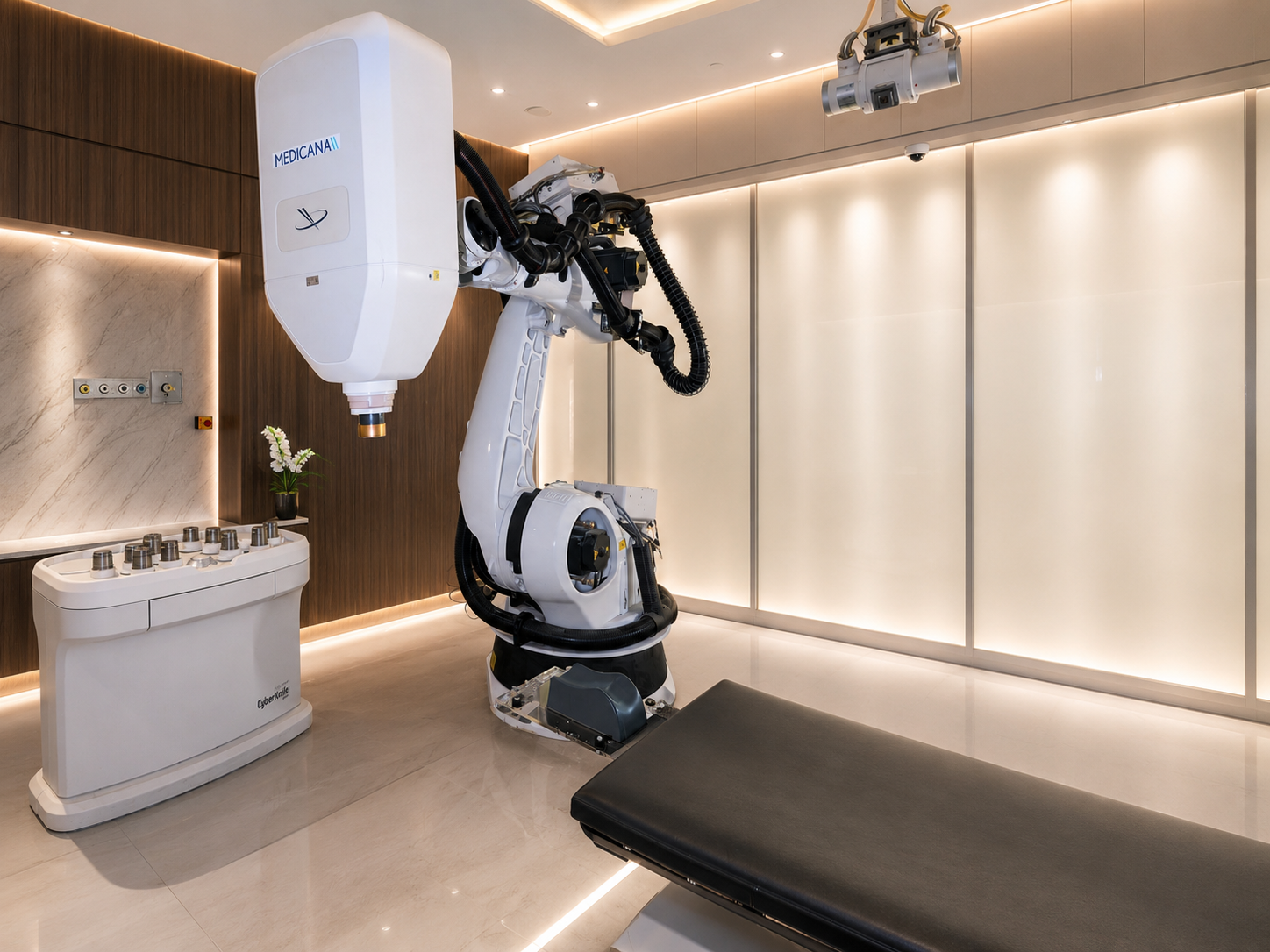
Photo: Medicana CyberKnife Operating Room via FL Comms
Radiation follows the tumor, not a fixed position
“In moving organs, the target can change position during treatment. CyberKnife continuously tracks these movements in real time and automatically adjusts the radiation beam according to the tumor’s position. This helps prevent unnecessary irradiation while protecting surrounding critical organs to the greatest extent possible,” Prof. Dr. Oysul said.
Prof. Dr. Oysul said this capability is especially relevant in stereotactic body radiotherapy (SBRT) and stereotactic radiosurgery (SRS), where treatment is delivered with a high degree of precision. The aim is to concentrate radiation on the tumor while better protecting surrounding healthy tissue.
Higher precision can expand treatment options
“With its robotic arm, image-guided treatment capabilities, respiratory motion management and real-time tumor tracking, CyberKnife gives us treatment possibilities that differ significantly from conventional radiotherapy. We can deliver higher radiation doses directly to the tumor with exceptional precision while better protecting surrounding healthy tissues, allowing us to provide more effective treatment with fewer side effects,” he said.
For selected patients, CyberKnife can also be considered when surgery is difficult or carries a high risk. Prof. Dr. Oysul noted that the system can eliminate the need for surgery in some patients or be used as a complementary treatment. The procedure is non-invasive, requires no surgical incision or general anesthesia, and most patients can return to daily activities shortly after treatment.
Used across a range of tumor sites
CyberKnife is used in the treatment of tumors involving the brain, spine, lungs, liver, pancreas, prostate and other anatomical sites. Prof. Dr. Oysul said radiation oncology has undergone a major technological transformation over the past three decades, with robotic delivery and advanced imaging now enabling highly focused treatment across different tumor locations.
“By combining robotic technology with advanced image-guidance systems, CyberKnife represents one of the most sophisticated platforms available for stereotactic radiosurgery today and plays an important role in modern cancer care,” Prof. Dr. Oysul concluded.
Media Contact
Uğur Alkapar
FL Communications
ugur@flcommunications.co.uk
+90 532 701 10 97
Photos accompanying this announcement are available at:
https://www.globenewswire.com/NewsRoom/AttachmentNg/b41922c8-6462-4f67-87e0-170afa73a801
https://www.globenewswire.com/NewsRoom/AttachmentNg/5debabd4-383c-4569-a9a9-2d843baaa565


